
Unlocking human potential through interdisciplinary scientific thinking.

/// Why we exist

Why we exist

We give kids problems worth wrestling with. They feel the power of their own thinking and learn to trust it. In a world with AI, it isn't enough to use technology. Children need to understand it: to think with and about it, question it, reason through it, and decide when to trust it.

Every choice a child will ever make rests on one thing: whether they trust their own thinking. That's where Thinkable started. Not as a coding app, but as a question: what if we taught children to think like scientists about hard problems, and turned technology into a playground for thinking?

/// How we do it

How we do it

Interdisciplinary Expeditions

Real thinking happens where disciplines meet. It isn't about learning to code, but knowing what to code and why, pulling in data and AI to wrestle with a problem that matters.

We ask before we tell

Hints nudge children to their own answer, never handed it. We guide the reasoning so they hit the gaps and traps themselves, building confidence, not dependency on technology.

Earned confidence

Crack something genuinely hard and kids start to trust their own thinking. They reach for the right method, learn on demand, and use any tool without hesitation.

/// How we got here

How we got here

2026Thinkable opens to everyone

Thinkable launches as a platform any curious thinker can join, taking on crewed expeditions guided by real mentors. The learning experiences, building on research that once lived in a research lab, are now open to everyone.

What we proved with a few hundred children is now within reach of everyone: the chance to build thinking they can trust.
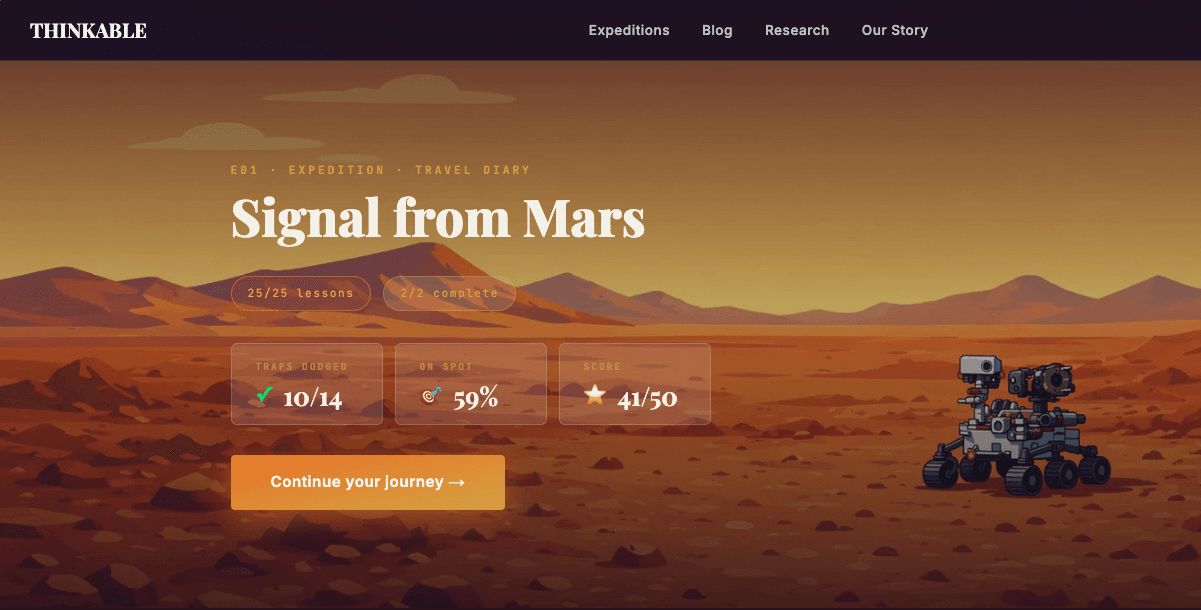
The Signal from Mars expedition — the first mission on the Thinkable platform

2025Out of the lab, into the world

The research worked, but it lived in a lab. So we took it outside: we ran three pilot holiday camps, Thinkable's first real courses beyond the study.

And when we used technology as a playground for genuinely complex problems, children could feel both the power and the limits of their own thinking. That's when thinking methods and strategic, critical thinking start to matter, because without them thinking turns chaotic and unreliable in the face of complexity.

So we shaped a thematic curriculum around thinking tools like risk analysis, pattern recognition, and perspective-shifting, so kids learn to think like scientists, not just be driven by technology.

★ Award winner · LeLa-Preis 2025

The LeLa-Preis 2025, awarded to our research project

Our research project RockStartIT was recognised with the LeLa-Preis, a German national award for outstanding hands-on STEM education.

2022 – 2024Proof it works

Across multiple schools and online, hundreds of children worked through the courses. The results were striking, and made clear this had to reach further.

Increased self-confidence. High interest in real-world problems and interdisciplinary thinking.
The science behind our method →
What changed through the courses
  • More interdisciplinary thinking, across all students
  • The students who started with the least confidence gained the most
  • Students found science and technology more relevant and interesting
Read the study →

2020 – 2021Where the method was forged

At the Karlsruhe Institute of Technology (KIT), we spent years studying how children really learn to think with technology, with over 400 kids. This is where the method was tested and sharpened: interdisciplinary, hands-on, and inclusive.

2019Where it started

Teaching computer science, we kept seeing two things. So many children hit a barrier with technology, and today that's a real disadvantage, because technology multiplies what a person can do. And teaching it for its own sake, coding just to code, falls flat: its power only shows when you apply it to something that matters.

No one knows what they're capable of until they try. The power to solve real problems with technology shouldn't belong to a few; it should be open to everyone.

Research-based

0+ children

Since 2019

/// Join an expedition

A new mission every month, join anytime.